
Soccer - Expected Effort
Now that everyone defends well, effort is what's left. An attempt to measure it.
Every rung
I've been playing soccer since I was three. I don't say that as a credential. As someone who doesn't shout or cheer at a screen, I tend to be analytical, observing the how and why of a match. I'm thirty, which is not old, but it's old enough that I've started watching the game differently than I ever played it.
I started on a neighborhood team called the Rockets, then tried out for and made the top side at a club that had just gotten off the ground. That was the highest I'd climb for a while. The club went through a reorganization, the coach I liked got pushed out, and the question of where to go next somehow landed on me at ten, and on my mom, who was never athletic and never had any feel for the politics of any of it. We did our best. The division-one teams she found turned out to be division three and four. I made them easily, and I didn't know what to do with that. I'd assumed I was walking into the same level I'd just left, so when the talent around me turned out to be plainly thinner, I felt two things that wouldn't square. I was proud I'd made it without being tested, and a little stunned that no one steering this had known enough to steer it better. My progress flattened while the kids I'd come up with kept climbing.
High school went better for a while. I made the sophomore team as a freshman, then JV the following year while subbing up for varsity, and finally made varsity my junior year, the same season our team reached the 5A state final and lost it. Then senior year the bottom fell out. We lost eighteen players. Two of us stayed, me and one other, and we lost all but one game the entire regular season. By the end I was done with it. I rowed in college instead and didn't touch a ball for years.
I came back the way a lot of people do, on a house rec team, half for the exercise and half because I missed it. One team led to another until I landed where I am now, in a competitive over-thirty indoor league sharing a field with men who did this for a living. Graham Zusi plays for our current team. Two others have ex-pros on them. I'm not the most talented player on any field I step onto anymore. What I am is the one watching.
And what I watch for has changed. As a kid you play on feel. You chase the ball, you want to win, and that's the whole of it. Somewhere along the way, having stood on every rung from the bottom to near the top and back down again, I stopped watching the score and started watching the machinery under it. How a team with no business winning finds a way. How a team stacked with talent can look like it would rather be anywhere else. That's the frame I can't switch off now, and it's the one I've been watching this World Cup through.
The eighty percent
The frame isn't really mine, but the number is. Pep Guardiola, who I think will be remembered as one of the best to ever coach the game, built his whole approach on where players stand before the ball ever arrives. He's said the worst blindness in football is to see only the ball. As far as I can find, he never put a figure on it. I have. If you asked me how much of a match is settled by positioning alone, by being in the right place before anything happens, I'd say eighty percent.
When I was younger I wouldn't have told you the game came down to talent, but talent was the only tool I had to measure it with. It was the thing I could see. The player who could do what no one else on the field could. Pep's way of seeing it handed me a better lens. It said that most of what decides a match isn't the moment of brilliance, it's whether eleven players are in the right places before the ball gets there. Being early. Being where the danger is going to be instead of where it already is. Once I had that lens I couldn't put it down, and I couldn't unsee how much of what I'd been calling skill was really just good position getting there on time.
For a while it looked like the idea might simply win. Pep's Barcelona was the cleanest proof of it anyone had built, Messi drifting into a system that bent the whole game around keeping the ball. Spain took the same blueprint and won everything in sight, a World Cup and two Euros on the spine of the same patience. When Pep moved on, the method moved with him to Bayern, and by then it had spread far enough that you could see its fingerprints on half the good teams in Europe. If you didn't have the ball, the thinking went, you were losing. And they made sure you rarely had it.
And then the game caught up to it, the way it always does. Teams stopped trying to out-possess the possession sides and started learning to survive them instead. Stay compact, let them have the ball where it couldn't hurt you, and wait. The bet was that you could stay focused longer than they could stay sharp, that a side in love with its own passing would eventually go loose, a half-step slow, and that the moment it did you could turn one stolen ball into the only goal that mattered. It worked often enough to change the sport. Holding the ball stopped being enough on its own. The teams that kept winning were the ones who could do something with it and also suffer without it.
And that's the part that interests me. If nearly everyone now sets up in roughly the right shape, and even the teams built to suffer do it on purpose and do it well, then the margin that actually separates them slides into the part of the game the positioning talk takes for granted. Pep never left effort out of it. His teams pressed like the shape was worthless without the running, and he's said it plainly: "I will forgive if the players cannot get it right, but not if they do not try hard." The positioning only ever worked because the work underneath it was assumed. What I think has happened is that the shape became common and the work didn't, so the thing everyone treats as a given is now the thing that decides games. That's what I want to talk about. It comes down to who is willing to work, and to how that willingness holds together, or falls apart, across eleven men.
Putting a number on effort
So how do you measure effort. The instinct is that you can't, that it's the one part of the game that resists a number, the part people fall in love with in the first place. I don't buy that. We already measure pieces of it without calling them effort. We track how far a player runs in a match and how many times he sprints. There's even a stat for how fast a team swarms the man on the ball after losing it, which is just a tidy way of asking how badly they want it back. The raw material is sitting right there. What nobody has done is assemble it into a single honest number.
The wrong way to assemble it is to total up the kilometers and crown the busiest team the one that tried hardest. That measure would lie, and it would lie in a way Pep himself would catch. Good positioning is supposed to save you running. If you're already where the ball is going, you don't have to chase it there. A well-organized side can cover less ground than the messy one it's pulling apart, because being in the right place is efficient. Raw distance rewards the headless and punishes the smart. Effort isn't motion. It's motion with a purpose under it, and motion the rest of the team is making with you.
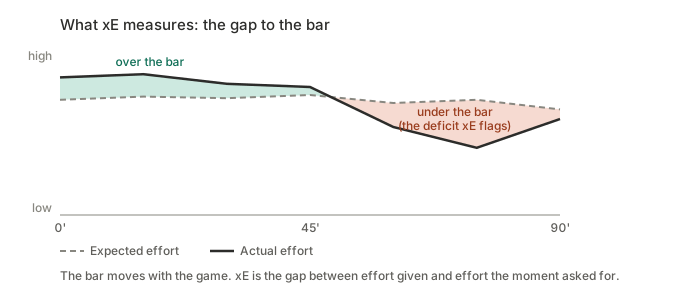
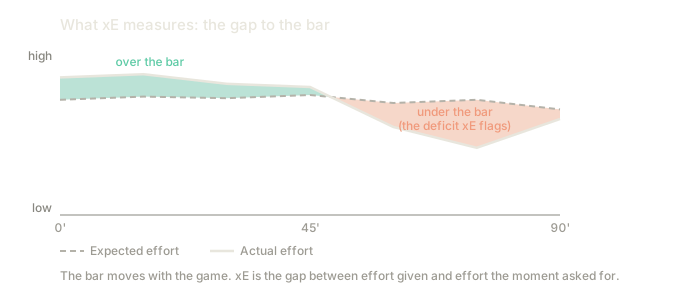
Here's where I'd borrow from xG, the stat that grades the quality of a chance instead of just whether it went in. xG never asks how many goals you scored. It asks how many you should have, given the chances you had, and the part that tells you anything is the gap between the two. I want that same logic aimed at effort. Given the scoreline, the opponent, and what's actually riding on the match, how hard should a team be working. Then measure what they did against that bar. That's what I mean by xE. The number was never the running on its own. It's the distance between the effort the moment asked for and the effort they gave.
That gap is the whole point, because it pulls apart two things that look the same on a flat stat sheet. A weak side pinned in its own half runs itself ragged and produces almost nothing, because it's being strangled. A strong side coasting on the ball can post low numbers too. Same quiet totals, opposite reasons. xE separates them by asking what was fair to expect. The minnow met its bar or beat it. The giant fell under its own. When I watched Portugal pass it sideways with the game in front of them and nothing threatening their goal, I wasn't seeing low effort in the abstract. I was seeing effort well below what that group, in that moment, had every reason to give. The thing I felt on the couch has a shape, and the shape is the gap.
Two players everyone argues about
The same blind spot shows up in players, not just teams. Take the two everyone still argues about, both past their primes now, both winding down in leagues a step below the ones that made them. On the surface they've aged into the same player. Neither tracks back. Neither wastes a stride he doesn't have to. By the hustle-back eye test you'd call them both lazy and move on.
Then look at what they each produced last season. Ronaldo scored twenty-eight goals and laid on two. Messi scored twenty-nine and laid on nineteen. That assist column is the whole story. Two goal totals within a hair of each other, and one of them was making the game for everyone around him while the other was waiting to be served. Watch them and you see the same split the numbers do. Messi never stops scanning, reading the shape of a move a beat before it forms, slipping into the gap the defense hasn't noticed yet. Ronaldo holds his spot and waits for the chance worth taking. One of them is working the whole time. It just isn't the kind of work that shows up as a sprint.
That's the trap sitting in the middle of my own metric. A version of xE built on distance and top speed would file both of them under low effort and be wrong twice. It would miss Messi's effort because his effort barely moves, almost all of it in his eyes and his first step. And it would misread Ronaldo, who isn't lazy so much as rationed, spending nothing until the half-second that pays. Neither of them is the Portugal problem. They're proof that the eye, and the raw number, can look right at effort and fail to see it.
The same divide at the World Cup
You can watch the same divide at the World Cup, in how each man is spent. Messi has been rationed. Rested, subbed, handed partial games, and still scoring in seven straight World Cup matches and bending the ones his team needed bent. When he's on, he creates and he chases, doing more defensive work than men half his age. Ronaldo played every minute of the group stage at forty-one, and for long stretches gave little but his presence, a blank here, a goal against the weaker side there, a team shaped to wait on him to settle it. Argentina rested their best player and won the group anyway. Portugal cannot seem to be built around anything but theirs. One man is enabling the ten around him. The other is the thing the ten are arranged to serve.
If you want the split in numbers, here is each man's group stage, three games apiece. They were in different groups, so this isn't head to head, just the same stretch of the tournament laid side by side.
| Messi | Ronaldo | |
|---|---|---|
| Minutes played | 200 | 270 |
| Shots | 15 | 13 |
| Chances created | 6 | 0 |
| Dribbles completed | 3 | 0 |
| Tackles won | 4 | 1 |
| Touches | 155 | 94 |
Nearly the same appetite to shoot across the three games, and almost nothing else held in common. One of them spent those matches pulling teammates into the game and chasing back to win the ball. The other spent his waiting for the chance worth taking, and little besides. The shots tell you both still want to score. Everything around the shots tells you only one of them was doing the rest of the work.
Building the number
I'm not going to pretend I can hand you the equation. I'm a player and a watcher, not a data scientist, and what follows is a sketch of what the number would have to account for, not a formula I could defend line by line. But I can tell you what goes into it, because the ingredients are things any of us can see from the stands.
Start with the plain physical ones. How far a player covers in a match, how fast he goes on average, and how often he actually hits top speed instead of coasting. Those are the raw measures of work, and on their own they're the trap I already named, the one that rewards the busiest team rather than the smartest. So you can't stop there.
The fix is to read that running against position, his and the ball's. A player sprinting to close a passing lane is doing something a player drifting the same distance away from the ball is not. Distance from the ball turns motion into intent. Pair it with where he's meant to be in the shape, and you begin to separate effort that holds the structure together from effort that's just spent.
Then the part that makes this xE and not a fitness report: over-expectation. Every one of those measures gets read against what the moment actually asked for. The scoreline, the time left, the quality of the side across from you, what's riding on the result. A team guarding a lead in the last ten minutes is allowed to run less than a team chasing a game it has to win, and the number should know the difference. What you're grading in the end isn't how hard they ran. It's how hard they ran against how hard they should have.
Two decisions live inside that, and I can describe them even if I can't formalize them. The first is what "should" means. If the bar is just what teams normally do, then a league full of sides happy to coast sets a low bar, and a coasting team clears it and looks fine. So the bar has to sit closer to what a committed side would give in that spot, not the average of what everyone actually gives. The second is how you turn eleven players into one number, and it can't be a straight average, for a reason I'll come to. It has to be a number that gets dragged down toward whoever is doing the least, so that one man checking out drags the team with him instead of hiding behind ten who didn't. Subs don't complicate this as much as you'd think. There are still eleven shirts on the field for ninety minutes, so each contribution is weighted by the minutes a player was on. That's the sketch. The exact machinery that would fold all of it into a single, trustworthy figure is past what I can honestly claim, and I'd rather leave that seam showing than dress it up as something I built.
Why it can't be an average
That second decision is the one I'll commit to hardest, because it's the whole point. The team's number can't be a straight average. An average lets one player burying himself cover for three others strolling, and the field never works that way.
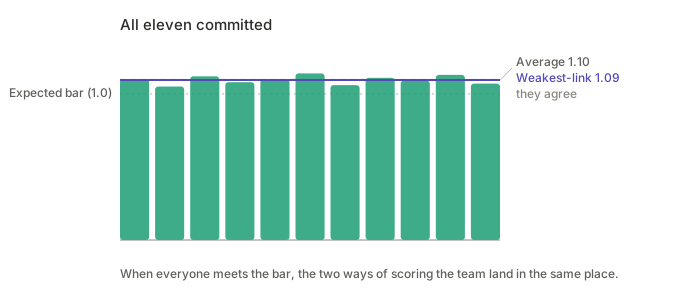
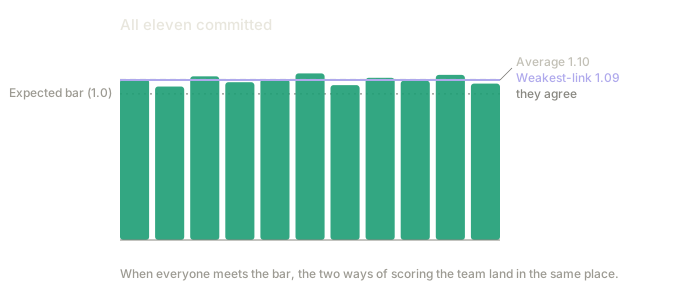
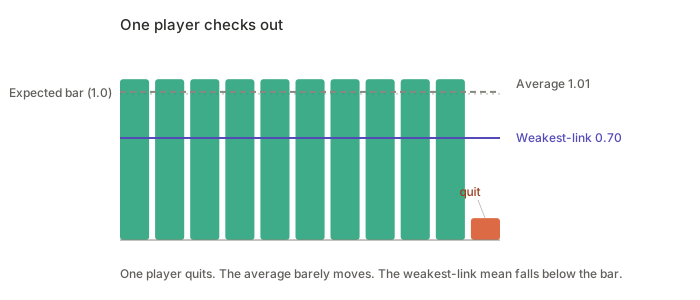
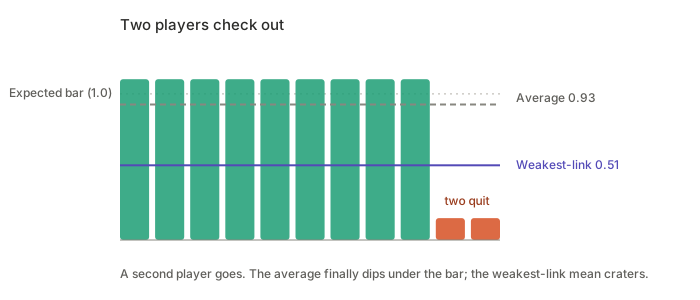
Watch what happens as players check out. The average barely flinches while the honest number, the one dragged toward the laggards, falls off a cliff. When one man quits, the average still reports that the team basically did its job. When a second goes, even the average finally concedes, but by then the honest number is on the floor. That collapse isn't a flaw in the math. It's the truest thing about the game. Why it has to work that way is the part I can only explain from the field.
What I can only explain from the field
When a press is working, trying is easy. That sounds backwards, because the press is the hardest running you do all game, but it holds. When all eleven of us are connected, when I close a lane and I can see the man next to me close his, the next sprint costs almost nothing. I'm not spending energy on faith. I can see it isn't being wasted. The effort feeds itself. Each player going full tilt makes it cheaper, not harder, for the next one to do the same, because the reward is right there in front of you, the turnover you're all about to force together. A team in that state isn't eleven people deciding to work. It's one thing, and the work is the easy part of it.
Then someone doesn't. A defender steps off, hands an open man an easy out, and the ball slides through the gap the rest of us were straining to close. What I feel in that moment isn't anger. It's the air going out. The sprint I just made was for nothing, and the one I was about to make suddenly costs everything, because now I'd be spending it on hope instead of on a sure thing. You feel the will drain out of the group in real time. The blame starts, out loud or just in the way a guy carries his shoulders. And the worst part is how fast it travels, faster than the trying ever did, because it only takes one man to start it and quitting hands everyone else permission. Why bury myself closing my lane if his stays open. The math that made effort cheap a minute ago runs backward, and the whole thing tips.
That's what people miss when they call a team lazy. Effort isn't eleven private choices that happen to line up. It's one system, and it wants to settle into one of two states. All in, where the work is cheap and pays for itself, or checked out, where every sprint feels pointless and nobody spends. There isn't much solid ground in between. And it tips on almost nothing, a missed press, a goal conceded, one player the others watch give up. The collapse doesn't ease in. It falls off a cliff.
This is why the team's number had to be dragged toward its worst contributor instead of averaged out. The man who steps off doesn't only subtract his own work, he taxes everyone else's. One quitter doesn't make the team a little worse. He makes the next man's effort feel wasted, and the one after that, until the whole chain is worth what its weakest link decided it was worth.
And that's the lens I've been watching this World Cup through. When Portugal strolls, I don't see eleven lazy men anymore. I see eleven good players whose collective engine never caught, who stopped spending once spending looked pointless. Talent didn't spare them the spiral. It just made the sideways passing look more expensive.
Names on paper
The freshest proof of all this came the day I was writing it. Germany, tenth in the world, went out of the World Cup to Paraguay, forty-first, beaten on penalties after a one-one draw. Look at the two team sheets and it should not have been close. Germany's is a roll call of the elite, Musiala and Wirtz and Havertz and Kimmich and Rüdiger and Neuer, men who start for the biggest clubs in Europe. Paraguay's has Almirón and Enciso and then a long list of names most fans outside South America would struggle to place.
The history only sharpens it. Germany are four-time world champions, yet this was their first knockout match since they lifted the trophy in 2014, having gone out in the group stage in both 2018 and 2022. A program made of famous names had not won a World Cup knockout game in more than a decade, and it did not win this one either. Paraguay had never even scored in the knockout rounds until Enciso's header. On paper it was no contest. On the field, Paraguay won.
And they won it without the ball. Germany had seventy-five percent of the possession and did almost nothing with it, passing it more than seven hundred times to Paraguay's hundred and sixty and still never finding a way through. Paraguay sat in a block, refused to come out of shape, and out-fought them for everything loose. With a quarter of the ball they won seventy-six duels to Germany's sixty. That is effort that never shows up as possession, the running you do when you don't have it, eleven men holding a line for two hours and making their one chance count through Enciso. Possession is not effort. This was the cleanest proof of that I saw all tournament.
Kimmich was the one German who didn't fit the pattern, and he makes the point better than anyone. He ran the game the way he always does, more touches than anyone on the field, forever trying to win the ball back high and drive his team up the pitch. None of it mattered. One man at full effort cannot lift ten who aren't with him, which is the whole reason the team's number can't be an average. His work was real, and it drowned, because the side around him never rose to meet it. The hardest worker on the field went home.
I won't pretend the result was pure justice. It went to penalties, and on the balance of the chances Germany were the better side, even had an extra-time winner ruled out before the shootout. So effort didn't win Paraguay the game so much as earn them the draw, and the draw earned them the coin flip, and the coin came up in their favor. Effort buys you the chance. It doesn't promise the result. Which is the honest place to stop, because the very next thing this World Cup taught me was the other side of that.
What the number can't do
Japan is where I have to be honest about what this number can't do, because Japan lost. They were the best argument for effort I saw all tournament and they still walked off beaten. Ahead early, swarming Brazil, putting even their stars under pressure. Then the second half came, Brazil turned it on, outran them, and put two past them. The team that tried harder lost. Any honest version of xE has to sit with that instead of flinching from it.
So the first bound is the plain one. xE is not a result. It measures what a team spent, not what they won. Japan cleared the bar the moment set for them and cleared it by a distance, and the score went the other way anyway. If I sold you a stat that promised the harder-working side wins, you could turn the Japan game off at the hour mark and prove me a liar. I'm not selling that. Effort is the underrated variable, not the only one.
The second bound is the one Japan teaches almost by accident, and it's about fuel. The pressing that strangled Brazil in the first half was not free. You cannot run at that pitch for ninety minutes on will alone, and the moment Japan's legs began to go, the gap they'd been closing by sheer effort opened back up. Brazil didn't suddenly start caring. They were simply still able to run when Japan no longer could, and once the racing evened out, the talent that had been penned in all half had room to walk through. Fitness is the ceiling on effort. You can want it as badly as you like. Your body decides how long the wanting lasts.
And that's the case that should keep me honest, because Brazil spent that first half looking exactly like the teams I've been accusing. Sitting off, letting Japan have the ball and the running. If I'd frozen the match at halftime I'd have filed them next to Portugal without a second thought. But they weren't the same. Portugal coasted and had nothing held back to justify it. Brazil coasted because they had a second half in their legs that Japan didn't, and a level in their feet that Japan couldn't match once the legs were even. The low effort looked identical from the outside. What separated them was whether anything was in reserve to make the gamble pay.
Which is the last thing xE measures, and maybe the most useful. Spending less effort than the moment asks is a bet. You're wagering that your quality, or your fitness late on, will cover the part you chose not to run. Brazil made that bet and had the talent to back it. Portugal made the same bet and lost it, because there was nothing underneath. The number doesn't tell you who wins. It tells you who is underspending, and then the game tells you who could afford to.
The slow version
I know the slow version of the spiral, because I played a whole season inside it. Mine stretched across months instead of a single press. We lost eighteen players, and my skill hadn't gone anywhere with them. I was the same player who'd been on the field for the state final the year before. What was gone was the will in the room, and I won't pretend I floated above it. I caught it like everyone else did.
The loss was profound. A game I had loved since I was three, I was made to hate, to loathe playing. As captain I was the leader of a team without hope, and I didn't have the knowledge yet to identify what in myself was so broken. A historic run for our school one year, and the next marred by failure. With no moxie in the room to push against, negative was the easy place to be, and it compounded. Each loss made the next one cost a little less, until I didn't want to fix it. I wanted out.
What I'm looking for now
I came back to the game eventually, the way you come back to anything that hurt you, slowly and as a watcher before a player. And what I've spent this whole piece doing is putting a number on the one thing I understood about that season without being able to name it at the time. That the will in a room is a real force, owned by no one player and shared by all of them, and that when it goes, it goes fast.
I can't hand you the equation for it. xE is a sketch drawn by someone who plays the game and watches it closely, not someone who could build the model that would make it real. The math that would fold a handful of honest ingredients into a single number is past me, and I'd rather leave the seam showing than pretend I'd closed it. But the thing the sketch points at doesn't need me to finish it to be true. You can feel the gap between the effort a moment asks for and the effort a team gives from the stands, long before anyone puts a figure on it.
Positioning won. It stopped being a style and became the floor, and once everyone stands in roughly the right place, the only thing left to separate them is how badly they want to be there, and whether that want holds across all eleven or breaks at the first man who stops. I think we'll see more of the teams that want it. Japan, ahead of Brazil on legs alone until the legs gave out. Cape Verde, who had no right to reach the knockouts and reached them anyway. I don't have the number that would prove any of it yet. But I know what I'm looking for now, which is more than I could say for a long time.
- June 29, 2026